
If the service light on a Kärcher HDS flashes, count the flashes in one complete sequence before switching the machine off. The count is a route into diagnosis, not proof that one particular part has failed. Water supply, wiring, sensors, moving safety components and the burner can all produce related symptoms.
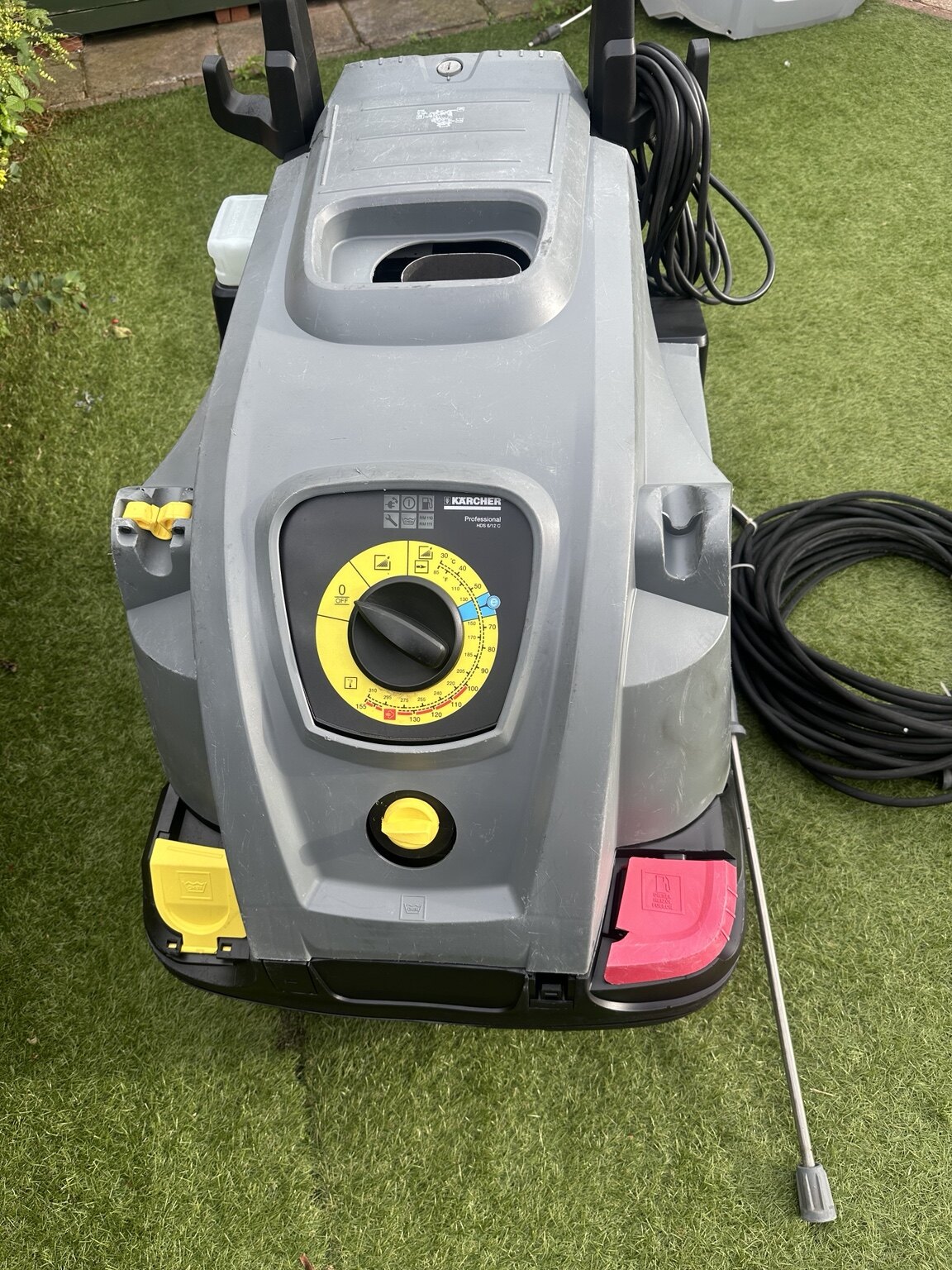
First check which HDS system you have
The flash-code table below comes from service information for the electronic HDS Compact family, including versions of the HDS 6/14, 7/16, 8/17 and 8/18. The HDS 5/12 covered by the same manual does not use this electronic fault display. Later HDS 6/12 machines and other generations can use different controls and code logic.
That distinction matters. A five-flash code on one electronic Compact model may lead towards the water-shortage safety, while a visually similar machine with a different board may use another sequence. Always match the code to the machine's model, serial number and service information.
HDS Compact service-light flash codes
| Flash pattern | Area indicated | Useful first observations |
|---|---|---|
| 1 flash | Dry running or a leak | Water supply, filters, trapped air and external leaks |
| 2 flashes | Supply voltage or excessive motor current | When it trips, the supply used and whether the motor labours |
| 3 flashes | Motor winding protection | Overheating, cooling time and whether the fault returns cold |
| 4 flashes | Exhaust-temperature or flame-monitoring fault | Whether the burner fired, smoke colour and when it cut out |
| 5 flashes | Water-shortage safety mechanism | Water flow, safety-block movement, sieve and reed-switch operation |
| 7 flashes | System-care RFID electronics | Container type, recognition and any recent replacement |
This is a diagnostic summary for the electronic Compact system in the referenced service information. It is not a universal code list for every Kärcher HDS.
One flash: dry run or leakage
The machine has detected repeated short starts or insufficient water flow. Start with the inlet rather than the pump internals: confirm an unrestricted supply, clean the coarse and fine filters, remove trapped air and inspect the high-pressure side for leakage. A tank-fed machine also needs airtight suction pipework; a missing O-ring or an air leak can prevent reliable priming.
Two flashes: voltage or motor current
This points towards the electrical supply or unusually high current draw by the motor. Record whether the fault appears instantly or only once pressure builds. Extension leads, poor connections, an incorrect supply and a mechanically loaded pump can all matter. Do not defeat protective devices or repeatedly reset a breaker.
Three flashes: winding protection
The motor's thermal protection is open or its circuit is faulty. Let the machine cool fully. If it runs again and then repeats the fault, the cause of the overheating still needs finding; cooling the motor is not the repair.
Four flashes: use the burner behaviour as context
The service information uses four flashes for two burner-related conditions: excessive exhaust temperature and a flame-monitoring fault. That is why the flash count alone is not enough. Note whether the burner lights, whether it produces white or black smoke, how long it runs and whether the code appears only after the machine becomes hot.
A high exhaust temperature can be associated with soot, restricted airflow, poor burner adjustment or a temperature-sensing fault. A flame fault directs attention towards ignition, the sight path or sensor, fuel delivery and combustion. Do not keep restarting a smoky burner: unburnt fuel can collect inside the boiler.
Five flashes: water-shortage safety
On this Compact system, five flashes indicates that the reed switch or the moving piston in the water-shortage safety may be sticking. Diagnosis should also include the safety-block sieve and actual water flow. The switch position should not be guessed or bypassed: it exists to stop the burner firing without reliable water flow.
Seven flashes: RFID electronics
This relates to the recognition electronics used with compatible system-care containers. Confirm that the correct container is fitted and seated properly. A recognition or electronics fault is different from simply needing more system-care liquid.
Solid warning lamps
A solid lamp can be just as useful as a flash sequence. Depending on model, dedicated lamps can indicate low fuel, low pump oil, an empty detergent tank, system-care level or incorrect phase rotation. Check the symbol against the operator manual for that exact machine. A full fuel tank, for example, does not prove that clean fuel is reaching the burner nozzle.
What to record before requesting a repair
- The complete model and serial number from the rating plate.
- Which lamp flashes and the number of flashes in one sequence.
- The selected programme and whether the trigger was open or closed.
- Whether normal pressure was present before the fault.
- Whether the burner fired, plus any smoke colour or diesel smell.
- Whether the code appears immediately or only once the machine is hot.
Those details let us test the correct circuit instead of treating a warning light as a parts list. For related symptoms, see our guides to an HDS burner that will not start and HDS pump seals and suction faults.
Book Kärcher HDS fault diagnosis →
Send the model and symptoms, or ask us to help match a machine to the work.